Homogenizers are advanced industrial machines designed to maintain product consistency, smooth texture, and uniform quality across various manufacturing processes. These machines are widely used in the food industry, pharmaceutical production, cosmetic manufacturing, dairy processing, and chemical applications to improve mixing efficiency, particle size reduction, product stability, and overall production performance.
In this blog, we will understand how the homogenization process helps create a uniform and stable mixture by reducing particle size, preventing ingredient separation, and ensuring even distribution throughout the product for improved quality, texture, consistency, and shelf life across various industrial applications.
What is a Homogenizer?
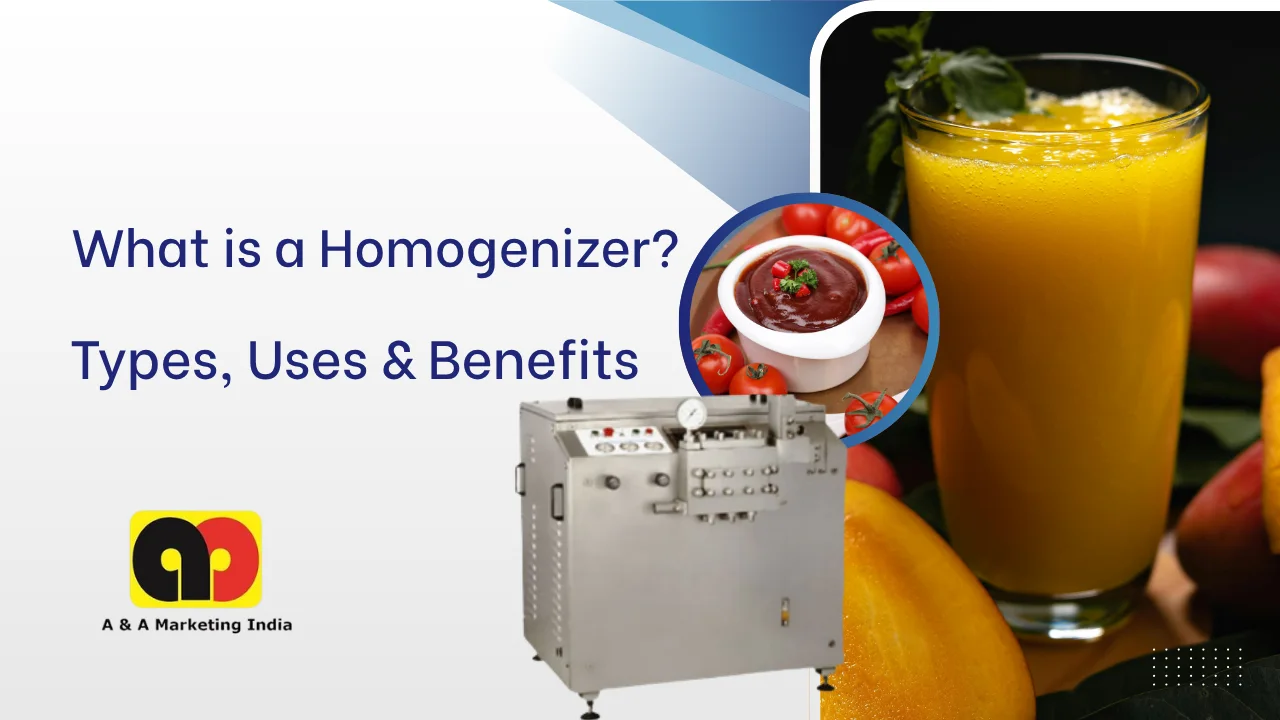
A homogenizer is an industrial machine used to reduce particle size and create a uniform mixture by applying high pressure, mechanical force, or shear force. The machine works by forcing liquid through a narrow gap at high pressure, breaking down particles into microscopic sizes.
The homogenization process is widely used in industries where product consistency and smooth texture are essential. It helps improve product appearance, viscosity, absorption, taste, and long-term stability.
For example, in milk processing, homogenization prevents cream from separating from milk. In pharmaceutical manufacturing, homogenizers help produce stable emulsions and suspensions for medicines and creams.
How Does a Homogenizer Work?
The working principle of a homogenizer involves applying mechanical energy to break down particles into smaller sizes. The liquid product is forced through a homogenizing valve or narrow chamber at extremely high pressure.
During this process:
- Large particles are broken into tiny uniform particles
- Ingredients are evenly distributed
- Product texture becomes smoother
- Separation of liquids and solids is minimized
- Emulsions become more stable
The homogenizer process creates a highly consistent and uniform product suitable for various industrial applications while providing better process control, precision mixing, improved particle size distribution, and enhanced product quality for efficient manufacturing performance.
Types of Homogenizers
Different industries require different homogenization methods according to product type, production capacity, and processing requirements. Below are the major types of homogenizers used in industrial applications.
High Pressure Homogenizer
A high-pressure homogenizer works by forcing liquid through a narrow valve under very high pressure. This creates intense turbulence and shear forces that break particles into microscopic sizes.
Features
- High efficiency mixing and emulsification
- Suitable for continuous production
- Produces ultra-fine particle size
- Improves product stability
- Available in different pressure capacities
Applications
- Dairy industry
- Pharmaceutical manufacturing
- Beverage processing
- Cosmetic products
- Food processing plants
Ultrasonic Homogenizer
An ultrasonic homogenizer uses high-frequency sound waves to create cavitation bubbles in liquid. These bubbles collapse rapidly and break down particles effectively.
Features
- Precise particle reduction
- Compact design
- Energy efficient operation
- Suitable for laboratory and industrial use
Applications
- Nanotechnology
- Biotechnology
- Chemical laboratories
- Pharmaceutical research
- Cosmetic formulations
Mechanical Homogenizer
Mechanical homogenizers use rotating blades, rotors, or stators to create strong mixing and shearing action.
Features
- Easy operation
- Cost-effective solution
- Suitable for medium viscosity products
- Durable construction
Applications
- Paint industry
- Food products
- Chemical mixing
- Cosmetic creams
- Industrial emulsions
Vacuum Homogenizer
Vacuum homogenizers combine homogenization and vacuum mixing technology to remove air bubbles from products during processing.
Features
Bubble-free product quality
Better texture and appearance
Improved shelf life
Efficient mixing performance
Applications
- Cosmetic creams
- Ointments
- Lotions
- Pharmaceutical products
- Personal care products
Inline Homogenizer
Inline homogenizers are installed directly in the production line for continuous processing.
Features
Continuous operation
High production efficiency
Reduced processing time
Consistent product quality
Applications
- Beverage manufacturing
- Food processing industries
- Chemical production
- Dairy plants
Uses of Homogenizers in Different Industries
Homogenizers are widely used across multiple industries because of their ability to improve product consistency and processing efficiency.
Food and Beverage Industry
Homogenizers are extensively used in food production to improve texture, flavor, and product stability.
Applications
- Milk homogenization
- Fruit juice processing
- Sauces and ketchup
- Ice cream production
- Mayonnaise manufacturing
- Dairy beverages
The homogenization process improves taste, texture, and shelf life while preventing ingredient separation.
Pharmaceutical Industry
In pharmaceutical manufacturing, homogenizers help produce stable and effective medicines.
Applications
- Creams and ointments
- Vaccines
- Injectable suspensions
- Syrups
- Drug emulsions
Cosmetic Industry
Cosmetic manufacturers use homogenizers to produce smooth and stable products.
Applications
- Skin creams
- Face lotions
- Hair products
- Sunscreen lotions
- Gel formulations
Homogenization ensures better texture, absorption, and appearance.
Chemical Industry
The chemical industry uses homogenizers for efficient mixing and particle reduction.
Applications
- Paints and coatings
- Lubricants
- Adhesives
- Detergents
- Industrial chemicals
Biotechnology Industry
Homogenizers are also used in cell disruption and laboratory research applications.
Applications
- Cell extraction
- Protein recovery
- Biological sample preparation
- Research laboratories
Benefits of Using a Homogenizer
Industrial homogenizers offer several advantages that improve manufacturing quality and production performance.
Improved Product Consistency
Homogenizers create a uniform mixture by evenly distributing particles throughout the product. This ensures consistent quality in every batch.
Better Product Stability
The homogenization process prevents separation of ingredients, improving product stability and shelf life.
Enhanced Texture and Appearance
Products become smoother, creamier, and visually more attractive after homogenization.
Increased Shelf Life
Smaller particle sizes reduce the chances of separation and spoilage, helping products last longer.
Faster Absorption
In pharmaceutical and cosmetic products, smaller particles improve absorption and effectiveness.
Efficient Production Process
Modern homogenizers improve production speed and reduce processing time, increasing overall efficiency.
Reduced Waste
Consistent mixing minimizes product rejection and material wastage during manufacturing.
Versatile Industrial Applications
Homogenizers can process liquids, emulsions, suspensions, creams, and viscous materials across multiple industries.
Important Factors to Consider While Choosing a Homogenizer
Homogenizer is important for achieving efficient production and consistent product quality. Before selecting a homogenizer machine, industries should consider several important factors for better performance and long-term efficiency.
- Product Viscosity – The machine should be suitable for handling thin or highly viscous materials efficiently.
- Required Particle Size – Choose a homogenizer according to the desired particle reduction and smoothness level.
- Production Capacity – Select equipment based on daily production volume and industrial requirements.
- Operating Pressure – High-pressure requirements depend on the type of product and processing application.
- Material Compatibility – Machine construction material should be compatible with chemicals, food products, or pharmaceutical ingredients.
- Automation System – Advanced automation improves operational control, accuracy, and production efficiency.
- Energy Efficiency – Energy-saving machines help reduce operational costs and improve productivity.
- Maintenance Requirements – Easy maintenance and cleaning reduce downtime and increase machine life.
- Durability and Build Quality – Strong construction ensures long service life and reliable industrial performance.
- Industry Application – Different industries require specific homogenizer designs according to processing needs.
A properly selected homogenizer helps improve product stability, processing efficiency, consistency, and overall industrial productivity.
Why Choose AA Marketing for Homogenizer Solutions?
AA Marketing provides reliable and high-performance homogenizer machines designed according to modern industrial processing needs. Our company focuses on quality engineering, durable construction, advanced technology, and efficient processing performance for different industrial sectors.
Our homogenizer systems are suitable for:
- Food processing industries
- Pharmaceutical production
- Cosmetic manufacturing
- Chemical industries
- Dairy applications
- Laboratory processing
We offer industrial solutions with strong performance, easy operation, low maintenance, and long service life.
Conclusion
Homogenizers have become an essential part of modern industrial manufacturing processes. They help improve product consistency, texture, stability, shelf life, and production efficiency across various industries. From dairy processing and pharmaceuticals to cosmetics and chemical manufacturing, homogenization technology plays a crucial role in delivering high-quality products.
With increasing industrial demand for precision processing and consistent quality, investing in a reliable homogenizer system is highly beneficial for manufacturers. AA Marketing offers advanced homogenizer solutions designed to meet diverse industrial processing requirements while maintaining high standards of quality, efficiency, and durability.